Blog
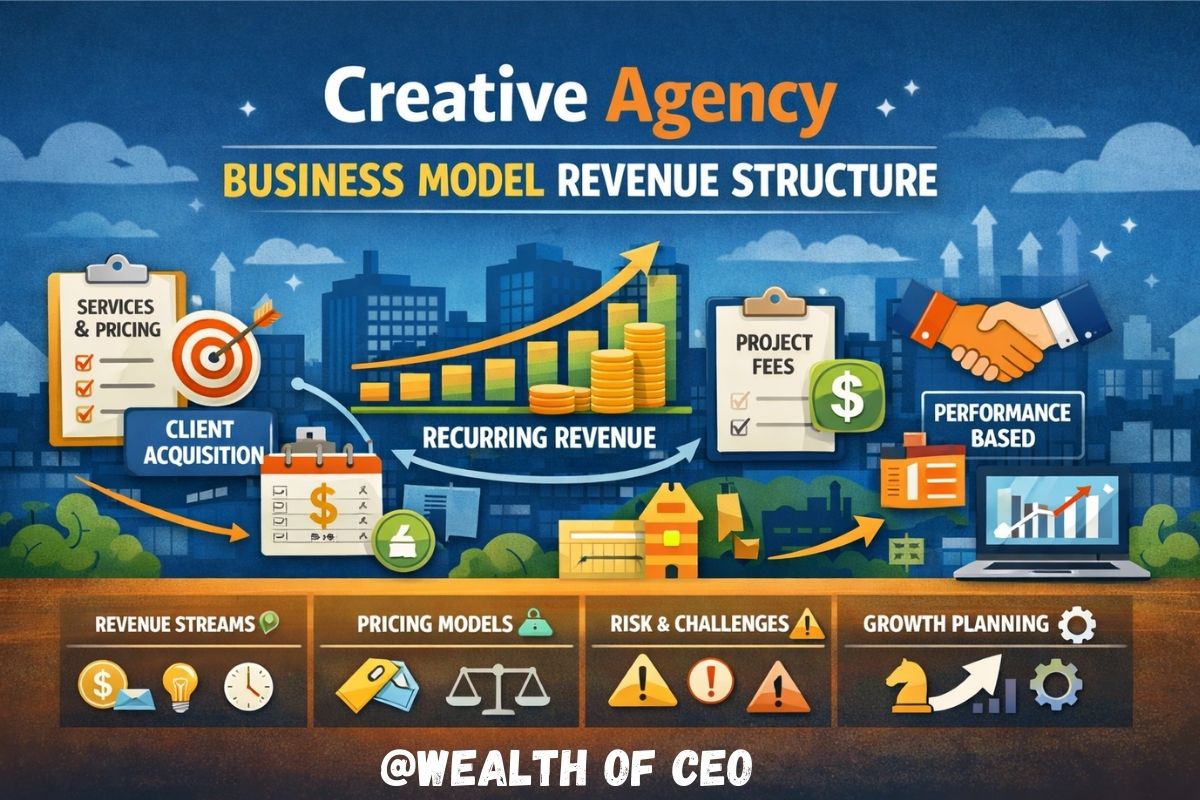
creative agency business model revenue structure
A creative agency business model revenue structure defines how an agency turns creative expertise into sustainable income. It goes beyond services and pricing to explain how value is created, delivered, billed, and retained over time. For agency leaders, operators, and decision-makers, this structure determines financial stability, growth potential, and how resilient the business is under market pressure.
Understanding revenue structure is not a theory exercise. It directly affects cash flow, hiring decisions, pricing confidence, client relationships, and long-term valuation. Agencies that clearly define how revenue is generated and protected are better positioned to scale responsibly, manage risk, and avoid common operational traps that limit profitability.
What Is a Creative Agency Business Model?
A creative agency business model explains how the agency creates value for clients and converts that value into predictable income.
It defines what the agency sells, who it serves, how work is delivered, and how money flows through the business.
-
Clarifies services, pricing logic, and target clients
-
Aligns operations, sales, and financial planning
-
Sets limits on what work the agency will and will not take
Business model vs revenue model explained
A business model describes the full operating logic, while a revenue model focuses only on how money is earned.
Both are connected, but they solve different problems.
-
Business model: services, positioning, delivery, costs, and value creation
-
Revenue model: pricing methods, billing cycles, and income sources
-
Strong agencies design the business model first, then choose revenue models that fit
How value creation connects to monetization
Agencies earn revenue by solving specific client problems, not by producing deliverables alone.
Monetization improves when value is clear, measurable, and tied to outcomes.
-
Strategic value supports higher pricing
-
Specialized expertise reduces price sensitivity
-
Clear outcomes justify retainers and long-term contracts
Core components of an agency business model
Every agency model is built on a small set of structural components.
Weakness in any one area usually shows up as margin or cash-flow issues.
-
Service offering and specialization
-
Target client profile and buying behavior
-
Pricing logic and cost structure
-
Delivery model and team utilization
How Creative Agency Revenue Structures Work
Revenue structures define how income is generated, billed, and collected over time.
They determine stability, risk exposure, and growth potential.
-
Mix of one-time and recurring revenue
-
Timing of invoices and payment terms
-
Relationship between delivery effort and income
Transactional vs recurring revenue flows
Transactional revenue is earned per project, while recurring revenue is earned on an ongoing basis.
Most agencies use a combination of both.
-
Transactional: higher short-term cash, less predictability
-
Recurring: steadier income, better planning
-
Mature agencies prioritize recurring revenue for stability
Client acquisition to revenue realization process
Revenue is realized only after a full chain of activities is completed.
Breakdowns anywhere in this chain delay or reduce income.
-
Lead generation and qualification
-
Proposal, pricing, and contract approval
-
Delivery, invoicing, and collections
How pricing, scope, and delivery affect cash flow
Cash flow depends on how tightly pricing and scope are controlled during delivery.
Loose scope management directly reduces realized revenue.
-
Fixed pricing requires strict scope definition
-
Delayed approvals slow invoicing
-
Over-servicing increases costs without increasing revenue
Common Revenue Streams Used by Creative Agencies
Agencies rely on multiple revenue streams to balance risk and opportunity.
Each stream comes with different margin profiles and management demands.
-
Short-term vs long-term income
-
Labor-intensive vs leverage-based revenue
-
Predictable vs variable demand
Project-based and fixed-fee engagements
Project-based work generates revenue for defined deliverables and timelines.
It is common for branding, campaigns, and website builds.
-
Easier to sell to new clients
-
Revenue ends when the project ends
-
Margins depend heavily on estimation accuracy
Monthly retainers and ongoing service contracts
Retainers provide recurring revenue for ongoing services.
They support better forecasting and operational stability.
-
Predictable monthly income
-
Stronger client relationships
-
Requires clear service boundaries to protect margins
Hourly billing and time-based pricing
Hourly billing charges clients based on time spent.
It is simple but limits scalability.
-
Transparent and flexible
-
Revenue capped by available hours
-
Often undervalues strategic thinking
Performance-based and outcome-driven revenue
Performance-based revenue ties payment to results achieved.
It shifts risk from the client to the agency.
-
Higher upside potential
-
Requires clear metrics and attribution
-
Risky without strong data control
Pricing Models That Shape Agency Revenue
Pricing models determine how value is translated into fees.
The wrong pricing model can undermine even strong demand.
-
Direct impact on margins
-
Influences client expectations
-
Shapes delivery behavior
Cost-plus and margin-based pricing
Cost-plus pricing adds a margin on top of delivery costs.
It is common in service-heavy agencies.
-
Easy to calculate
-
Encourages time-based thinking
-
Can lock agencies into low-margin work
Value-based pricing for strategic services
Value-based pricing charges based on client outcomes rather than effort.
It works best for high-impact, advisory-led services.
-
Decouples revenue from hours
-
Supports premium positioning
-
Requires confidence and clear value articulation
Hybrid pricing models used by growing agencies
Hybrid models combine multiple pricing approaches.
They balance risk and flexibility.
-
Fixed fees plus retainers
-
Base retainer with performance incentives
-
Allows gradual pricing evolution
Roles and Responsibilities in Revenue Generation
Revenue is not owned by sales alone.
Multiple roles influence how much revenue is earned and retained.
-
Strategic decisions
-
Client management
-
Delivery discipline
Leadership and revenue strategy ownership
Leadership sets pricing standards and revenue priorities.
Inconsistent leadership decisions often cause pricing erosion.
-
Approves pricing frameworks
-
Defines acceptable margins
-
Controls discounting behavior
Sales, account management, and upselling roles
Sales and account teams convert demand into structured revenue.
They protect revenue by managing expectations early.
-
Qualification and scoping
-
Contract terms and renewals
-
Identifying expansion opportunities
Delivery teams and revenue efficiency
Delivery teams determine whether revenue is profitable.
Efficiency directly affects realized margins.
-
Time management and estimation
-
Scope control during execution
-
Documentation and change requests
Why Revenue Structure Matters for Agency Growth
Revenue structure shapes how an agency grows and how resilient it is.
Poor structures amplify risk during market changes.
-
Cash flow stability
-
Hiring confidence
-
Long-term planning
Revenue predictability and financial stability
Predictable revenue allows agencies to plan staffing and investments.
It reduces reliance on constant new sales.
-
Stable monthly income
-
Lower stress on sales pipeline
-
Better decision-making
Scalability limitations of different models
Not all revenue models scale equally.
Some models increase workload faster than income.
-
Hourly billing scales linearly
-
Retainers scale with systems and process
-
Productized services scale best
Impact on valuation and long-term sustainability
Revenue quality affects how agencies are valued.
Recurring revenue increases perceived stability.
-
Higher valuation multiples
-
Easier succession or exit planning
-
Lower client concentration risk
Benefits of Different Revenue Models for Stakeholders
Each stakeholder benefits differently depending on the revenue model.
Alignment improves retention and performance.
-
Owners seek predictability
-
Clients seek clarity
-
Teams seek stability
Benefits for agency owners and partners
Owners benefit from revenue structures that reduce volatility.
Consistency supports long-term strategy.
-
Predictable income
-
Clear growth levers
-
Reduced operational surprises
Benefits for clients and long-term relationships
Clients benefit when pricing matches expectations.
Clear models reduce conflict.
-
Transparent costs
-
Consistent service levels
-
Long-term planning support
Benefits for teams and operational planning
Teams perform better with predictable workloads.
Revenue structure influences morale.
-
Stable capacity planning
-
Reduced burnout
-
Clear performance expectations
Best Practices for Building a Sustainable Revenue Structure
Sustainable revenue structures are intentional, not accidental.
They evolve as the agency matures.
-
Balance risk and reward
-
Protect margins
-
Support delivery quality
Balancing recurring and project-based income
A balanced mix reduces dependence on any single revenue type.
Most stable agencies prioritize recurring income.
-
Retainers for baseline revenue
-
Projects for growth and innovation
-
Regular review of revenue mix
Client concentration and revenue diversification
Over-reliance on a few clients increases risk.
Diversification improves resilience.
-
Revenue caps per client
-
Industry diversification
-
Multiple service lines
Aligning pricing with positioning and expertise
Pricing must reflect how the agency positions itself.
Misalignment causes friction and churn.
-
Specialist agencies charge premiums
-
Generalists compete on efficiency
-
Pricing signals market positioning
Financial and Operational Requirements to Support Revenue
Revenue structures fail without supporting systems.
Operations must match the revenue design.
-
Cost visibility
-
Forecasting discipline
-
Legal clarity
Cost structure and margin management
Understanding costs is essential for pricing decisions.
Hidden costs erode profitability.
-
Fixed vs variable costs
-
Utilization tracking
-
Margin targets per service
Revenue forecasting and capacity planning
Forecasting connects revenue to staffing decisions.
Poor forecasting leads to over- or under-hiring.
-
Pipeline weighting
-
Retainer renewal tracking
-
Capacity utilization forecasts
Legal and contractual considerations
Contracts define how revenue is protected.
Weak contracts expose agencies to unpaid work.
-
Clear scope definitions
-
Payment terms and timelines
-
Change order mechanisms
Common Revenue Mistakes and Risks in Creative Agencies
Many agencies struggle due to avoidable revenue errors.
These issues compound over time.
-
Pricing inconsistency
-
Poor scope control
-
Weak enforcement
Over-reliance on hourly billing
Hourly billing limits growth and pricing power.
It anchors value to time, not impact.
-
Caps revenue potential
-
Encourages inefficiency
-
Difficult to scale
Underpricing creative and strategic work
Creative work is often underpriced due to confidence gaps.
This leads to chronic margin pressure.
-
Fear of client pushback
-
Lack of value framing
-
Inconsistent pricing standards
Revenue leakage from scope creep
Uncontrolled scope directly reduces effective revenue.
It is one of the most common agency issues.
-
Informal client requests
-
Poor documentation
-
Weak change management
Tools and Systems That Support Agency Revenue Management
Systems help enforce discipline across revenue activities.
They reduce reliance on individual judgment.
-
Visibility
-
Consistency
-
Accountability
CRM and sales pipeline tools
CRMs track opportunities and conversion rates.
They support revenue forecasting.
-
Lead qualification
-
Deal stage visibility
-
Renewal tracking
Project management and time tracking systems
These systems connect delivery effort to revenue.
They reveal margin risks early.
-
Scope tracking
-
Time vs budget monitoring
-
Delivery accountability
Financial reporting and profitability tools
Financial tools show where money is made or lost.
They support strategic decisions.
-
Service-level profitability
-
Client margin analysis
-
Cash flow monitoring
Actionable Checklist for Designing an Agency Revenue Model
A structured checklist prevents reactive decisions.
It keeps revenue design aligned with strategy.
-
Clear inputs
-
Repeatable logic
-
Ongoing review
Defining your core services and pricing logic
Start by clarifying what you sell and why.
Pricing should follow service definition.
-
Core vs optional services
-
Standardized packages
-
Pricing rationale
Selecting the right revenue mix
Choose revenue streams that match maturity and risk tolerance.
Avoid copying competitors blindly.
-
Target recurring percentage
-
Project selectivity criteria
-
Performance-based limits
Monitoring performance and adjusting structure
Revenue models require regular review.
Markets and clients change.
-
Margin tracking
-
Client feedback
-
Annual pricing reviews
Comparing Creative Agency Revenue Models
Different models suit different agency types.
There is no single best structure.
-
Depends on services
-
Depends on market
-
Depends on goals
Retainer-first vs project-first agencies
Retainer-first agencies prioritize stability.
Project-first agencies prioritize flexibility.
-
Retainer-first: predictable, slower growth
-
Project-first: variable, higher risk
-
Many agencies blend both
Boutique vs full-service agency revenue structures
Boutique agencies focus on depth.
Full-service agencies focus on breadth.
-
Boutique: higher margins, fewer clients
-
Full-service: broader revenue base
-
Operational complexity varies
Traditional agencies vs productized service models
Productized models package services into repeatable offers.
They improve scalability.
-
Traditional: custom, relationship-driven
-
Productized: standardized, system-driven
-
Hybrid models are increasingly common
FAQs
1. What determines how a creative agency generates revenue?
A creative agency generates revenue based on its service mix, pricing model, delivery approach, and client contract structure. Factors like specialization, client size, and recurring service demand play a major role in shaping income consistency and margins.
2. How does a creative agency business model revenue structure impact profitability?
A creative agency business model revenue structure impacts profitability by controlling how predictable income is, how costs scale with delivery, and how much pricing power the agency retains. Agencies with recurring and value-based revenue typically maintain healthier margins than those relying only on hourly billing.
3. Are retainers better than project-based revenue for agencies?
Retainers are generally more stable than project-based revenue because they provide predictable monthly income. However, project-based work can support growth and experimentation when paired with clear scope control and accurate pricing.
4. Why do many creative agencies struggle with cash flow despite strong demand?
Many agencies struggle with cash flow due to delayed invoicing, weak payment terms, scope creep, and over-servicing. Revenue issues are often operational rather than demand-related.
5. How often should an agency review its revenue model?
Agencies should review their revenue model at least annually or whenever there are major changes in services, pricing, or client mix. Regular reviews help identify margin erosion and alignment issues early.

Blog
Fuelcell Energy Cumulative MW Deployed 2023
FuelCell Energy cumulative MW deployed 2023 reflects the total operational capacity and technology footprint achieved by the company in that year. This figure highlights the scope of FuelCell Energy’s stationary fuel cell installations, including both assets it directly operates and systems deployed under partner agreements. Understanding these numbers provides insight into the company’s market presence and its contribution to low‑emission, distributed energy generation.
Tracking cumulative MW deployed is critical for assessing growth, performance, and competitive positioning within the stationary fuel cell industry. In 2023, FuelCell Energy expanded its portfolio across the U.S. and international markets, including Korea, reinforcing its role in supporting renewable energy targets and providing reliable, on-site power solutions for industrial and utility applications.
Understanding FuelCell Energy and Its Technology
What is FuelCell Energy?
FuelCell Energy is a U.S.‑based company that designs, manufactures, installs, operates, and services stationary fuel cell power systems for distributed energy and hydrogen production. Its platforms produce electricity with low emissions and are used by utilities, industrial customers, and municipalities.
-
Provides utility‑scale and on‑site generation systems
-
Technologies support hydrogen production, carbon capture, and energy storage
-
Operates global fuel cell projects with recurring service revenue
Key Technologies and Platforms in Use
FuelCell Energy uses multiple fuel cell technologies with different use cases and power outputs.
-
SureSource Platforms: Series of carbonate fuel cell systems ranging from small kW to multi‑MW capacity
-
Tri‑Gen Systems: Produce electricity, heat, and hydrogen for industrial use
-
Solid Oxide Platforms: Higher‑efficiency, low‑rare‑earth material systems under development
-
Platforms can operate on natural gas, hydrogen, biogas, or blends depending on site requirements
Differentiation from Other Fuel Cell Manufacturers
FuelCell Energy differentiates based on scale, integration, and service model.
-
Focuses on stationary, grid‑connected, and industrial installations vs. automotive or portable use
-
Integrated project delivery (design through operations)
-
Long‑term service and maintenance agreements for installed projects
-
Technology designed for combined heat and power applications
Defining Cumulative MW Deployed
Operational Capacity vs. Technology Deployment
Operational capacity refers to megawatts recognized on the company’s balance sheet as functioning generating assets. Technology deployment includes systems installed by partners that use FuelCell Energy designs.
-
Operational MW: Systems owned/operated by the company
-
Technology deployed MW: Installations using FuelCell Energy technology but serviced or owned by partners
How Cumulative MW is Calculated in Energy Projects
Cumulative deployed MW is the sum of all operational capacity installed across projects up to a given date.
-
Add MW from all commissioned systems
-
Exclude projects pending commissioning or not yet recognized in operating portfolio
-
Include partner deployments only when under company service or revenue arrangements
FuelCell Energy’s 2023 Deployment Overview
Total MW Deployed Globally
FuelCell Energy reported its generation operating portfolio reached over 60 MW by the end of its fiscal year on October 31, 2023.
-
Reflects MW capacity of assets officially recognized as operating
-
Represents the core generation fleet contributing to recurring revenue
Regional Deployment Breakdown (U.S., Korea, Other Markets)
Deployments in 2023 included capacity in North America and technology platforms overseas.
-
U.S. deployments: Multiple utility‑scale projects including a new generation park in Connecticut
-
Korea: Fuel cell platforms deployed at six sites totaling more than 100 MW using company technology, though not all counted on FuelCell’s own operating books
-
Other markets may include pilot and service agreements in development
Project Highlights and Milestones
2023 saw key projects reach service milestones and new agreements.
-
New generation park opened in Derby, Connecticut
-
Long‑term service agreement executed for a 20 MW plant in Korea
-
University and municipality projects awarded to build additional small MW systems
How Fuel Cell Deployment Works
From Manufacturing to Site Installation
Deployment starts with manufacturing components and assembling fuel cell systems.
-
Components produced at Torrington, CT facility
-
Systems delivered to sites with civil and electrical infrastructure prepared
-
Installation includes connecting fuel supply and interfaces with grid or load systems
Grid Integration and Power Output Monitoring
Once installed, systems must interface with local distribution or generation networks.
-
Interconnection equipment ensures compatibility with grid codes
-
Output meters and telemetry track power production and system health
-
Contracts often include requirements for power quality and reliability
Maintenance and Performance Verification
Fuel cell systems require ongoing maintenance to sustain output and longevity.
-
Scheduled module replacements drive service economics
-
Performance data reviewed to anticipate issues and optimize operation
-
Extended service agreements can reduce outages and lifecycle costs
Key Roles and Stakeholders in Deployment
FuelCell Energy Project Teams
Internal teams coordinate deployment from design through commissioning.
-
Engineering and project management
-
Field installation and commissioning crews
-
Operations and maintenance specialists
-
Back office support for contracts and reporting
Partners, Contractors, and Technology Licensees
External stakeholders support installation and long‑term service.
-
System integrators and construction firms
-
Licensed technology operators in regions like Korea
-
Independent service providers under long‑term agreements
Regulatory and Utility Stakeholders
Regulators and utilities influence deployment timelines and interconnection.
-
Utility grid operators set standards for interconnection
-
Permitting authorities set environmental and safety requirements
-
Energy policy bodies support renewable or clean energy incentives
Why Cumulative MW Matters to the Industry
Market Share and Competitive Positioning
Cumulative deployed MW indicates a company’s footprint relative to peers.
-
Higher installed capacity can signal market traction
-
Investors use MW totals to benchmark growth potential
-
MW figures reflect adoption of specific fuel cell technologies
Impact on Renewable Energy Goals
Fuel cell deployments contribute low‑emission generation capacity.
-
Helps utilities and governments meet clean energy targets
-
Provides baseload solutions where intermittent renewables dominate
-
Supports decarbonization strategies in industrial sectors
Significance for Investors and Analysts
MW deployed is a quantitative measure used in financial and operational analysis.
-
Influences revenue forecasts for service and performance contracts
-
Used to assess manufacturing capacity utilization
-
Impacts long‑term valuation models in cleantech portfolios
Benefits of FuelCell Energy Deployments
Environmental and Sustainability Advantages
Fuel cell systems reduce emissions compared to combustion generators.
-
Low‑particulate and low‑NOx emissions
-
Can use biogas or hydrogen to further reduce carbon footprint
-
Quiet operations suitable for urban environments
Economic and Operational Benefits for Partners
Deployments deliver financial and reliability advantages.
-
Combined heat and power can reduce energy costs
-
Service contracts provide predictable maintenance expenses
-
Distributed generation reduces transmission losses
Reliability and Energy Security Contributions
Fuel cells offer resilient power delivery.
-
On‑site generation can provide backup power
-
Stable output supports critical infrastructure
-
Reduces dependence on central grid during outages
Best Practices for Tracking and Reporting MW Deployment
Standard Metrics and Reporting Methods
Use consistent measures to report deployed MW.
-
Distinguish between commissioned and planned capacity
-
Report operational output versus nameplate capacity
-
Use third‑party verification where available
Lessons from Successful Deployments
Track performance against expectations to improve accuracy.
-
Benchmark similar projects for expected output
-
Adjust forecasts based on real operation data
-
Document commissioning dates and service start dates
Avoiding Data Misrepresentation
Be clear on what constitutes deployed capacity.
-
Do not count uncommissioned systems
-
Separate partner‑installed technology from contracted operating assets
-
Clarify whether deployment includes observed or rated output
Compliance and Regulatory Considerations
Environmental Permitting and Safety Requirements
Deployments must comply with local and national regulations.
-
Air quality permits often required
-
Safety plans for hydrogen handling and fuel storage
-
Site‑specific environmental impact assessments
Grid and Utility Interconnection Standards
Generators must meet interconnection requirements.
-
Voltage, frequency, and protection criteria set by utilities
-
Certification of equipment may be required
-
Agreements define responsibilities for outages and faults
International Deployment Guidelines
Cross‑border projects require adherence to multiple regimes.
-
Import/export rules for power equipment
-
Local committee approvals for generation sources
-
International standards for safety and performance
Common Challenges and Risks in Deployment
Technical and Operational Challenges
Fuel cell deployments face complex integration issues.
-
Precision manufacturing to ensure system reliability
-
Site‑specific installation obstacles
-
Commissioning and tuning for optimal output
Financial and Market Risks
Economic factors can slow deployment.
-
Capital intensity and financing complexity
-
Policy changes affecting incentives
-
Market competition from other energy sources
Risk Mitigation Strategies
Mitigate risks with careful planning and partnerships.
-
Secure long‑term service agreements
-
Use phased deployment to manage cash flow
-
Engage experienced integrators and utilities
Tools, Systems, and Technologies Supporting Deployment
Monitoring Software and Performance Analytics
Digital tools track and optimize deployed systems.
-
Remote telemetry for power and temperature data
-
Alerts for maintenance needs
-
Analytics to predict performance trends
Manufacturing and Installation Tools
Specialized equipment ensures quality and efficiency.
-
Precision fabrication tools in manufacturing facilities
-
Rigging and installation tools for site assembly
-
Calibrated instruments for testing and commissioning
Industry Partnerships and Platforms
Collaborative tools extend deployment reach.
-
Partner networks for local installation and service
-
Platforms that share best practices and data
-
Standards bodies promoting interoperability
Actionable Deployment Checklist for Energy Professionals
Pre-Deployment Planning Steps
Start with clear objectives and compliance checks.
-
Define capacity targets and site requirements
-
Confirm permits and interconnection agreements
-
Line up contractors and logistics
Site Installation and Commissioning
Ensure installation is systematic and documented.
-
Verify civil and electrical infrastructure
-
Test fuel supply and safety systems
-
Perform commissioning tests for power stability
Post-Deployment Monitoring and Reporting
Track performance from day one.
-
Regular data collection on output and efficiency
-
Schedule maintenance based on performance trends
-
Report operational capacity to stakeholders
Comparison with Other Fuel Cell Manufacturers
MW Deployment Metrics Across Competitors
Fuel cell peers vary in scale and application.
-
Some specialize in smaller distributed systems
-
Others focus on heavy industrial hydrogen production
-
Comparisons should use consistent MW measures across markets
Technology and Market Differentiators
Different manufacturers have different strengths.
-
Some excel in mobile or transportation markets
-
Stationary fuel cells like FuelCell Energy focus on baseload power
-
Materials and stack design impact efficiency and cost
Regional Deployment Strategies
Deployment varies by region based on policy and infrastructure.
-
North America may focus on grid resilience
-
Asia and Europe may emphasize decarbonization goals
-
Incentives drive adoption in some markets more than others
FAQs
What is the total cumulative MW deployed by FuelCell Energy in 2023?
The total operational capacity reported by FuelCell Energy in 2023 reached over 60 MW, including both directly operated assets and partner-deployed systems in regions like Korea.
How does FuelCell Energy calculate deployed MW?
Deployed MW includes all commissioned and operational fuel cell systems recognized in the company’s portfolio. Systems installed by partners may be counted once under service or revenue agreements.
What regions saw the highest fuel cell deployments in 2023?
The United States led in utility-scale deployments, while Korea accounted for significant partner-deployed MW using FuelCell Energy technology. Other regions include pilot projects and smaller commercial installations.
What are the benefits of tracking cumulative MW deployed for energy projects?
Tracking deployed MW helps evaluate market share, operational efficiency, and environmental impact. It also informs investment decisions and supports compliance with renewable energy standards.
How does FuelCell Energy compare to other fuel cell manufacturers?
FuelCell Energy focuses on stationary, distributed power systems with multi-MW capacity, distinguishing it from competitors that may prioritize smaller systems, transport applications, or specialized industrial use.
Blog
ECG Components Lab NoteBook
Accurate ECG documentation is essential for both learning and clinical practice, and the ecg components lab notebook serves as a structured tool to record and analyze cardiac activity. It allows students and practitioners to track P waves, QRS complexes, T waves, intervals, and segments systematically, ensuring that every observation is clear, precise, and replicable. By organizing ECG data effectively, users can compare normal and abnormal patterns, making the lab notebook an indispensable part of physiology education and practical training.
Using an ecg components lab notebook also supports consistent measurement, annotation, and interpretation of heart signals. Whether in a classroom or clinical setting, it provides a reliable reference for understanding cardiac conduction, evaluating heart rhythms, and maintaining high standards of documentation. A well-maintained lab notebook not only enhances learning but also builds foundational skills necessary for professional practice in cardiology and related health sciences.
Understanding ECG: Basic Overview
What is an Electrocardiogram (ECG)?
An ECG is a test that records the heart’s electrical activity.
-
It captures the depolarization and repolarization of the heart muscle.
-
Each heartbeat produces a waveform that reflects cardiac conduction.
-
These waveforms help identify normal and abnormal heart rhythms.
Historical Development and Clinical Relevance
ECGs have been used clinically for over a century.
-
Early techniques involved string galvanometers and paper tracings.
-
Modern digital ECGs provide high-resolution signals for diagnosis.
-
ECGs are essential in cardiology, emergency medicine, and physiology education.
Core Components of an ECG
P Wave: Atrial Depolarization Explained
The P wave represents atrial depolarization.
-
Occurs as the atria contract to push blood into the ventricles.
-
Typically upright in most leads, small in amplitude, and short in duration.
-
Recording this wave helps assess atrial function and rhythm regularity.
QRS Complex: Ventricular Depolarization
The QRS complex shows ventricular depolarization.
-
It triggers ventricular contraction, producing the main heartbeat force.
-
Duration is brief, usually 0.06–0.12 seconds.
-
Its morphology can indicate conduction abnormalities or heart disease.
T Wave: Ventricular Repolarization
The T wave represents ventricular repolarization.
-
Ventricles return to their resting electrical state.
-
Usually upright and follows the QRS complex.
-
Changes in T-wave shape or amplitude may signal ischemia or electrolyte imbalance.
Other Key Elements: U Wave, PR Interval, ST Segment
-
U Wave: Small wave following T wave; may indicate late repolarization.
-
PR Interval: Time from the start of the P wave to the beginning of QRS; reflects AV node conduction.
-
ST Segment: Flat segment after QRS; deviations can indicate ischemia or infarction.
How an ECG Works
Electrical Conduction in the Heart
The heart generates electrical impulses that coordinate contraction.
-
SA node initiates depolarization, spreading through atria.
-
AV node delays impulse before ventricular conduction.
-
Bundle branches and Purkinje fibers distribute the signal throughout ventricles.
Recording Techniques: Leads and Electrodes
Electrodes detect electrical activity from different angles.
-
Standard 12-lead ECG provides multiple views of heart activity.
-
Limb and chest electrodes are placed in precise anatomical positions.
-
Proper electrode placement ensures accurate and reproducible tracings.
Reading and Interpreting Tracings
Interpreting ECGs involves analyzing waveforms, intervals, and segments.
-
Compare each wave’s amplitude and duration to normal ranges.
-
Identify rhythm, conduction, and possible abnormalities.
-
Document findings systematically in the lab notebook.
Documenting ECG in a Lab Notebook
Standard Lab Notebook Formats for ECG
Lab notebooks typically use tables and diagrams.
-
Columns for waves, intervals, and observations.
-
Space for measurement values and annotations.
-
Templates may follow standardized academic or clinical guidelines.
Organizing Waves, Intervals, and Segments
Structure documentation sequentially.
-
Record each P wave, QRS complex, and T wave.
-
Note intervals like PR, QT, and RR for each tracing.
-
Label abnormalities clearly for reference and discussion.
Including Measurements and Observations
Measurements should be precise and repeatable.
-
Use a ruler or digital software to determine durations.
-
Record heart rate calculated from RR intervals.
-
Include qualitative observations: waveform morphology and irregularities.
Roles and Responsibilities in ECG Recording
Student/Practitioner Responsibilities
Students or practitioners must record accurate tracings.
-
Follow standard electrode placement.
-
Maintain clean, functional equipment.
-
Document findings in a clear, consistent format.
Instructor or Supervisor Oversight
Supervisors ensure data quality and student adherence.
-
Verify correct technique and tracing quality.
-
Provide feedback on measurements and annotations.
-
Confirm safety protocols during ECG recording.
Ensuring Accurate Data Capture
Accuracy requires attention to detail.
-
Minimize artifacts from movement or electrical interference.
-
Calibrate machines regularly.
-
Review recordings before final documentation.
Importance of Proper ECG Documentation
Academic Significance in Physiology Labs
Correct documentation supports learning.
-
Helps students understand cardiac conduction in practice.
-
Facilitates grading and instructor evaluation.
-
Provides a reference for future experiments.
Clinical Relevance for Future Practice
Accurate records support clinical decision-making.
-
Enables comparison with patient ECGs.
-
Helps detect subtle changes over time.
-
Provides legal and professional documentation of findings.
Avoiding Misinterpretation and Errors
Clear documentation reduces mistakes.
-
Mislabeling or missing waves can lead to incorrect conclusions.
-
Systematic recording prevents data loss and miscommunication.
-
Observational notes clarify unusual patterns.
Benefits of a Well-Structured Lab Notebook
For Students: Improved Learning and Retention
A structured notebook enhances understanding.
-
Visual organization aids memory.
-
Stepwise measurements improve analytical skills.
-
Supports self-assessment and review.
For Educators: Easier Assessment and Feedback
Teachers can quickly evaluate progress.
-
Standardized tables simplify grading.
-
Annotations highlight strengths and errors.
-
Consistency allows comparison across students.
For Clinical Applications: Reliable Reference
Professional use benefits from detailed records.
-
Provides baseline data for patient monitoring.
-
Serves as a reference for research or case studies.
-
Facilitates collaboration with colleagues.
Best Practices for ECG Lab Notebooks
Standardized Notation and Labeling
Use consistent symbols and units.
-
Clearly mark wave peaks and intervals.
-
Include lead identification and tracing date.
-
Avoid ambiguous abbreviations.
Using Diagrams and Annotations Effectively
Visual aids complement written data.
-
Sketch representative ECGs with labeled components.
-
Highlight abnormalities with arrows or color codes.
-
Include notes on unusual findings or measurement tips.
Maintaining Consistency Across Experiments
Consistency ensures reliable comparisons.
-
Follow the same format for all recordings.
-
Use uniform scales for amplitude and timing.
-
Update templates as protocols evolve.
Common Mistakes and Risks
Mislabeling Waves and Intervals
Incorrect labeling can invalidate data.
-
Verify P, QRS, and T wave identification.
-
Double-check interval measurements.
-
Confirm electrode placement for accurate signals.
Incorrect Measurements or Calculations
Errors in timing or amplitude distort interpretation.
-
Use calibrated tools or software for precision.
-
Repeat measurements for verification.
-
Note any anomalies or artifacts observed.
Poor Recording Techniques
Artifacts can affect ECG quality.
-
Ensure electrodes have good skin contact.
-
Avoid movement during recording.
-
Monitor equipment performance before and during use.
Tools and Techniques for Accurate ECG Documentation
ECG Machines and Software Interfaces
Modern ECG machines provide reliable recordings.
-
Digital machines often include automatic measurements.
-
Software can annotate waves and generate reports.
-
Ensure familiarity with the interface to avoid errors.
Digital vs. Manual Recording Methods
Both methods are valid depending on context.
-
Manual: precise, low-tech, good for learning measurement skills.
-
Digital: faster, allows automated analysis and storage.
-
Hybrid approaches combine both for verification.
Annotation and Diagramming Tools
Tools support clear documentation.
-
Use colored pens or digital markers for labeling.
-
Include grids for accurate amplitude and time representation.
-
Maintain organized diagrams for each lead.
Actionable Checklists for Students
Pre-Recording Checklist
-
Verify electrode placement and skin prep.
-
Calibrate ECG machine and check leads.
-
Prepare lab notebook and templates.
During Recording Checklist
-
Monitor signal quality continuously.
-
Label each waveform as it occurs.
-
Measure intervals and note observations.
Post-Recording Verification Checklist
-
Review tracings for clarity and completeness.
-
Double-check measurements and labels.
-
Save or scan digital recordings for reference.
Comparing Lab Notebook Approaches
Digital vs. Paper Lab Notebooks
-
Digital allows easy storage, search, and sharing.
-
Paper supports tactile learning and immediate annotation.
-
Both can complement each other for verification and backup.
Standardized Templates vs. Freeform Notes
-
Templates ensure consistency and completeness.
-
Freeform notes allow flexibility for unusual cases.
-
Combining both approaches often works best.
Pros and Cons of Each Method
-
Digital: efficient but dependent on power/software.
-
Paper: reliable, portable, but harder to organize long-term.
-
Choice depends on lab environment and learning goals.
Additional Resources for ECG Study
Recommended Textbooks and Guides
-
“Rapid Interpretation of ECGs” by Dale Dubin
-
“ECG Made Simple” by John R. Hampton
-
Standard physiology lab manuals
Online ECG Simulators and Tools
-
Web-based ECG simulation software
-
Virtual labs for student practice
-
Measurement tools for interval calculation
Peer-Reviewed Articles and Lab Manuals
-
Journal of Electrocardiology
-
American Heart Association educational resources
-
University lab manuals for physiology courses
FAQs
How do I measure the PR, QRS, and QT intervals accurately?
Accurate measurement requires identifying the start and end points of each wave on the ECG tracing. Use calipers or digital tools to mark the beginning and end of the P wave, QRS complex, and T wave. Repeat measurements to ensure consistency.
What is the normal duration for each ECG component?
-
P wave: 0.08–0.11 seconds
-
PR interval: 0.12–0.20 seconds
-
QRS complex: 0.06–0.12 seconds
-
QT interval: 0.36–0.44 seconds
Comparing these durations to your recordings helps identify potential abnormalities.
How should I organize my ecg components lab notebook?
Use a consistent layout with sections for waves, intervals, segments, and observations. Include labeled diagrams, measurement tables, and notes on any irregularities. Standardized templates can improve clarity and make reviewing data easier.
Can lab notebooks be used for clinical reference?
Yes. When properly recorded and annotated, lab notebooks provide reliable baseline data and support analysis. Ensure measurements, dates, and lead placements are clearly documented.
What are common errors when documenting ECGs in a lab notebook?
Typical mistakes include mislabeling waves, inaccurate measurements, poor electrode placement, and incomplete observations. Systematic recording and double-checking data reduce these errors.
Blog
Experiment 38 Pre Laboratory Assignment
Pre-laboratory assignments are an essential part of laboratory courses, helping students prepare thoroughly before performing experiments. The Experiment 38 pre laboratory assignment specifically focuses on qualitative analysis of common cations, guiding students to understand chemical reactions, predict outcomes, and organize their observations systematically. Completing this assignment ensures students are ready to perform the experiment efficiently and safely, while also reinforcing the theoretical concepts behind each test.
The Experiment 38 pre laboratory assignment also teaches important laboratory skills such as identifying ions through precipitation, flame tests, and gas evolution. By working through this assignment in advance, students can anticipate challenges, plan their procedures, and maintain accurate documentation. This preparation not only improves lab performance but also enhances conceptual understanding, making it a critical step in achieving reliable and meaningful results.
What Is a Pre-Laboratory Assignment?
Definition and Purpose in Chemistry Labs
A pre-laboratory assignment is a task students complete before performing the lab experiment.
-
Ensures students understand the theory behind the experiment.
-
Helps identify reagents, procedures, and safety requirements.
-
Allows students to anticipate outcomes and plan observations.
-
Serves as a reference to reduce errors during actual lab work.
Difference Between Pre-Lab and Post-Lab Work
Pre-lab work is done before the experiment, while post-lab work is done after completion.
-
Pre-lab focuses on preparation, predictions, and understanding procedures.
-
Post-lab focuses on analyzing results, drawing conclusions, and documenting findings.
-
Pre-lab helps reduce mistakes; post-lab ensures learning from the results.
Overview of Experiment 38
Objectives of the Experiment
The main goal of Experiment 38 is to identify and analyze specific cations in a solution.
-
Confirm the presence of ions such as Na⁺, K⁺, NH₄⁺, Mg²⁺, Ca²⁺, and Cu²⁺.
-
Understand chemical reactions used for separation and identification.
-
Develop laboratory skills for observation, recording, and analysis.
Key Concepts and Chemistry Principles
This experiment is based on qualitative chemical analysis principles.
-
Precipitation reactions to separate cations.
-
Flame tests for characteristic colors of ions.
-
Formation of complex ions and gas evolution for identification.
-
Understanding solubility, reactivity, and selective separation techniques.
Core Reagents and Materials
List of Required Chemicals and Equipment
The experiment requires both chemicals and basic lab equipment.
-
Chemicals: Sodium chloride, potassium chloride, ammonium salts, magnesium salts, calcium salts, copper salts, acids, and bases.
-
Equipment: Test tubes, beakers, pipettes, centrifuge, Bunsen burner, flame test tools, and safety goggles.
Safety Considerations and Handling
Proper safety reduces risk of accidents and contamination.
-
Always wear protective gear including gloves and goggles.
-
Handle acids and bases with care; use fume hoods when needed.
-
Label all reagents clearly to prevent cross-contamination.
-
Follow disposal guidelines for chemical waste.
Step-by-Step Pre-Lab Process
How to Read the Lab Manual Effectively
Start by scanning the lab manual to identify key sections.
-
Highlight objectives, reagents, and safety notes.
-
Note procedural steps that require special attention.
-
Make margin notes on chemical reactions and expected results.
Preparing Your Assignment Before the Lab
Pre-lab preparation involves writing down expected observations and calculations.
-
List reagents and their roles.
-
Predict outcomes for each test or reaction.
-
Prepare diagrams or tables to organize data.
Recording Observations and Predictions
Documenting predictions allows comparison with actual results.
-
Use tables to note predicted colors, precipitates, or gas formation.
-
Include expected solubility and reaction sequences.
-
Leave space for actual observations during the lab.
Common Pre-Lab Questions
Understanding Ion Identification
Ion identification relies on characteristic reactions.
-
Precipitate formation separates ions based on solubility.
-
Flame tests indicate the presence of specific cations.
-
Gas evolution confirms ions like NH₄⁺.
Explaining Chemical Reactions and Equations
Accurate explanations require writing clear reaction equations.
-
Include reactants, products, and conditions for each reaction.
-
Highlight color changes, precipitate formation, or gas release.
-
Explain why certain reagents selectively react with specific ions.
Predicting Experiment Outcomes
Predictions help avoid errors and improve understanding.
-
Consider solubility rules and ion reactivity.
-
Anticipate order of precipitate formation in mixtures.
-
Predict flame colors and complex ion formations for reference.
Importance of Completing Pre-Lab Assignments
Academic Benefits for Students
Pre-lab work directly impacts performance and understanding.
-
Improves test scores and lab grades.
-
Enhances comprehension of theory and procedures.
-
Builds analytical and problem-solving skills.
Enhancing Lab Safety and Efficiency
Preparation reduces errors and hazards during the experiment.
-
Familiarity with reagents minimizes accidental spills.
-
Awareness of procedures prevents delays and confusion.
-
Proper documentation ensures faster, accurate analysis.
Best Practices for Pre-Lab Preparation
Organizing Notes and References
Structured notes improve clarity and retrieval during the lab.
-
Separate theory, reagents, and procedures.
-
Use bullet points or tables for quick reference.
-
Cross-reference with textbook examples.
Using Diagrams and Tables for Clarity
Visual tools make complex processes easier to follow.
-
Draw flowcharts for ion separation sequences.
-
Use tables for expected reactions, precipitates, and colors.
-
Include diagrams of test setups or flame test placements.
Time Management Tips
Effective planning avoids last-minute errors.
-
Allocate time for reading, note-taking, and prediction exercises.
-
Break tasks into smaller steps for accuracy.
-
Complete the pre-lab at least a day before the lab session.
Common Mistakes and How to Avoid Them
Misunderstanding the Experiment Objectives
Ignoring objectives leads to incorrect predictions.
-
Review the purpose of each step before writing.
-
Highlight key ions and reactions for focus.
Incomplete or Incorrect Reagent Lists
Missing reagents can halt the experiment or cause errors.
-
Double-check chemical names, formulas, and quantities.
-
Ensure all necessary equipment is noted.
Poor Documentation of Observations
Unclear notes lead to confusion during actual experiments.
-
Maintain organized tables for predictions and observations.
-
Write legibly and consistently for all data points.
Tools and Techniques to Support Pre-Lab Work
Laboratory Manuals and Online Resources
Reliable references ensure accurate preparation.
-
Use the official lab manual for experiment instructions.
-
Consult verified online chemistry guides and databases.
-
Reference safety sheets for chemical handling.
Digital Templates and Assignment Checklists
Templates streamline the pre-lab process.
-
Use standardized pre-lab forms for predictions and observations.
-
Check off steps to confirm all tasks are completed.
Visualization Tools for Reaction Processes
Visual aids clarify complex chemical interactions.
-
Diagram reaction sequences for ion separation.
-
Use color-coded charts for flame tests and precipitate identification.
-
Interactive simulations can reinforce understanding.
Sample Pre-Lab Assignment Template
Step-by-Step Example Completion
A template guides consistent pre-lab documentation.
-
Fill in experiment title, date, and student name.
-
List reagents, equipment, and safety notes.
-
Predict reactions, colors, and precipitate formation.
How to Answer Standard Questions Correctly
Accuracy comes from understanding the chemistry behind each question.
-
Explain reactions with chemical equations.
-
Justify predictions based on solubility and reactivity.
-
Include expected observations in structured tables.
Comparing Approaches
Individual vs Group Pre-Lab Assignments
Both approaches have advantages depending on learning style.
-
Individual: Encourages personal understanding and accountability.
-
Group: Facilitates discussion and clarifies difficult concepts.
-
Hybrid: Combines independent work with peer verification.
Manual vs Digital Pre-Lab Preparation
Preparation can be traditional or tech-assisted.
-
Manual: Paper notes, hand-drawn diagrams, physical tables.
-
Digital: Templates, online simulations, editable charts.
-
Choose method based on lab requirements and personal efficiency.
FAQs
How do I prepare for Experiment 38 pre-laboratory assignment?
Review the experiment objectives, list reagents, predict reactions, and organize observations clearly in tables.
What are the most common ions tested in Experiment 38?
Na⁺, K⁺, NH₄⁺, Mg²⁺, Ca²⁺, and Cu²⁺ are typically analyzed during this experiment.
How detailed should my pre-lab observations be?
Include predicted colors, precipitates, gas evolution, and reaction sequences in a structured format.
Can I work on the pre-lab assignment in groups?
Yes, group discussions can clarify difficult concepts, but each student should complete their own documentation.
Are there digital tools to help with Experiment 38 pre-laboratory assignments?
Templates, online simulations, and visualization charts can assist in predicting reactions and organizing data efficiently.
-
Net Worth11 months agoMarlo Thomas Net Worth: Comparing Her Earnings to Other Hollywood Icon
-
Net Worth11 months agoDannielynn Birkhead Net Worth: Did She Inherit Any Money from J. Howard Marshall?
-
Net Worth11 months agoJimmy Carr Net Worth: The Impact of TV Hosting and Digital Media on His Wealth
-
Net Worth11 months agoBilly Strings Net Worth: How Much Does He Make from Tours and Streaming?
-
Net Worth11 months agoTommy Lee Net Worth: How His Reality TV Appearances Boosted His Income
-
Biography5 months agoKate Garraway New Partner: A Complete Look at Her Life and Journey
-
Net Worth11 months agoCharleston White Net Worth: How He Built His Multi-Million Dollar Empire
-
Net Worth11 months agoMyron Golden Net Worth: Passive Income Strategies That Made Him a Millionaire