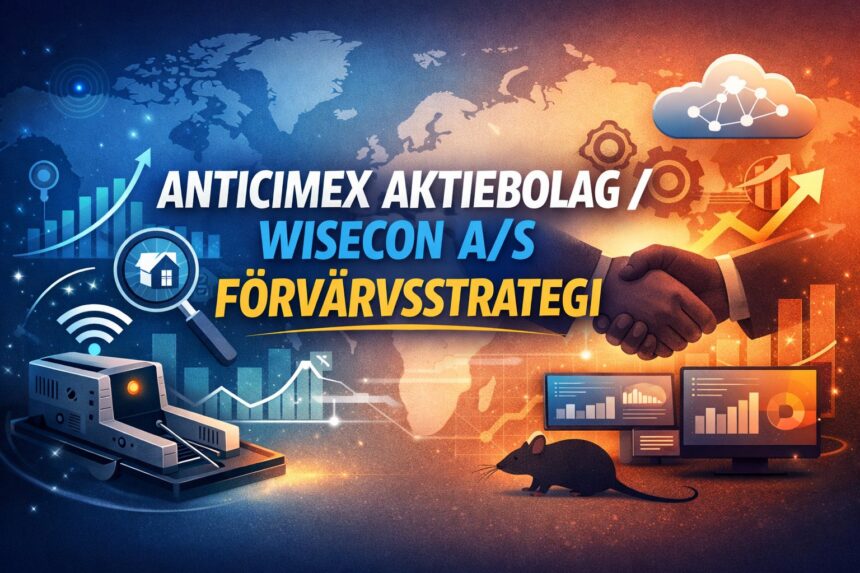
What Is the Anticimex / Wisecon Förvärvsstrategi?
The word förvärvsstrategi is Swedish for acquisition strategy. It refers to the structured plan a company uses to grow by buying other businesses instead of building everything from scratch. In the world of pest control and facility services, this approach has become one of the most effective ways to enter new markets, gain new technologies, and scale operations quickly.
The Anticimex Aktiebolag / Wisecon A/S Förvärvsstrategi is a specific case that has drawn attention from business leaders, technology strategists, and industry analysts across Europe and beyond. It represents how a large, established service company can transform itself by carefully choosing the right partner and integrating their innovation into a much bigger operational network.
What makes this strategy truly stand out is not just the deal itself. It is the thinking behind it. Rather than rushing into a full takeover, Anticimex took a patient, phased approach that prioritized understanding, trust, and long-term alignment before committing fully. That kind of careful execution is rare in modern corporate development.
Anticimex Aktiebolag: The Company Behind the Strategy
Anticimex is a Swedish company founded over 80 years ago. What began as a traditional pest control operation has grown into a multinational service organization with a presence across 17 countries. Its operations span Europe, North America, Asia, and Australia, making it one of the most recognized names in professional pest management worldwide.
Over the years, Anticimex made a deliberate shift from reactive pest control to preventive, technology-driven solutions. This shift required more than internal development. It required strategic partnerships and targeted acquisitions that could fast-track the company’s digital ambitions. The Wisecon A/S acquisition became a defining chapter in that journey.
The company’s growth model is built on the idea that every acquisition should add real value, not just size. Anticimex identifies businesses that bring specific expertise, existing customer relationships, or innovative technology that fits within its long-term vision. This disciplined approach separates it from companies that grow simply for the sake of numbers.
Who Is Wisecon A/S?
Wisecon A/S is a Danish technology company that specializes in intelligent pest monitoring systems. The company developed electronic traps and sensor-based tools that do more than just capture pests. They collect real-time data, send automated alerts, and allow remote monitoring of pest activity without requiring constant physical inspections.
By 2016, Wisecon had grown significantly. The company had doubled its revenue to 90 million DKK and turned a previous small loss into a healthy post-tax profit of 16 million DKK. With 56 employees and a suite of proprietary monitoring technologies, the company had proven itself as a credible, commercially successful innovator in a niche that was about to become very important.
Wisecon did not just build better traps. It built a smarter way of thinking about pest control: collect data continuously, act only when needed, and let technology do the watching so humans can focus on solving real problems.
That combination of financial stability, skilled personnel, and future-ready technology made Wisecon a perfect fit for Anticimex’s strategic goals. It was not just a business to buy. It was a capability to absorb and scale across an international network.
How the Acquisition Happened: A Two-Phase Approach
Anticimex did not walk in and buy Wisecon overnight. The strategy unfolded in two deliberate phases. In January 2015, Anticimex acquired a 20 percent minority stake in Wisecon. This initial investment served as a test period. It allowed Anticimex to evaluate the technology in real conditions, assess the team’s competence, and understand how well the two companies could work together before making a bigger commitment.
This phase of the acquisition was about observation and validation, not control. By holding a minority stake, Anticimex kept its risk manageable while gaining direct insight into Wisecon’s operations, culture, and technical performance. Very few companies exercise this kind of patience in deal-making. Most want fast results. Anticimex prioritized certainty over speed.
Once the partnership proved its value, Anticimex moved to full acquisition, integrating Wisecon’s assets, team, and technology into its global innovation framework. Crucially, the acquired company was allowed to retain a level of local autonomy. This preserved the creativity and agility that made Wisecon successful in the first place, while giving it access to global resources it could never have reached independently.
Technology at the Heart of the Strategy
One of the most important aspects of the Anticimex / Wisecon Förvärvsstrategi is its emphasis on digital transformation. Technology is not treated as a bonus feature here. It is a central pillar of every acquisition decision. When Anticimex evaluates a potential target, the company’s technological capabilities are just as important as its revenue, customer base, or geographic presence.
Wisecon’s core technologies brought three major capabilities to the table:
- Automated Pest Monitoring: Electronic traps and IoT sensors detect pest activity in real time, eliminating the need for scheduled manual inspections at every location.
- Predictive Analytics: Historical data and live sensor feeds are analyzed to predict where pest problems are likely to emerge before they become visible.
- Cloud-Based Reporting Dashboards: Customers and technicians can access transparent, real-time data about service activity, outcomes, and trends from anywhere.
These tools shifted pest control from a reactive service into a proactive discipline. Instead of waiting for a customer to call about an infestation, Anticimex can now detect early signals and respond before the problem escalates. This improves outcomes for customers, reduces operational costs for technicians, and cuts down on chemical usage, which supports sustainability goals at the same time.
The integration of digital infrastructure also supports scalability in a very practical way. When Anticimex acquires a new local company in a new market, Wisecon’s standardized platforms can be deployed quickly to bring that company up to the same level of service quality. Technology becomes the connective tissue between a global brand and its many local operations.
The Local-First Global Expansion Model
A major reason this strategy works is the local-first philosophy behind it. Anticimex does not enter new markets by planting a corporate flag and starting from zero. Instead, it acquires established local businesses that already have customer trust, knowledge of local regulations, and experienced staff who understand the pest patterns and environmental conditions of their region. That kind of knowledge cannot be manufactured. It can only be inherited.
After an acquisition, local management is encouraged to continue leading day-to-day operations. Anticimex provides strategic support, centralized training programs, and access to its global technology and resource network, but it does not micromanage from Stockholm. This balance of local expertise and global backing is what makes the model both efficient and sustainable over the long term.
This approach also reduces the risk of brand disruption. Customers in any given market continue dealing with a company they already know and trust. The transition from local operator to Anticimex-backed service provider happens gradually and smoothly, rather than through an overnight rebrand that could create confusion or erode loyalty.
Key Benefits of the Strategy
The Anticimex Aktiebolag / Wisecon A/S Förvärvsstrategi delivers benefits at multiple levels, from the boardroom to the customer’s door. At the business level, the strategy accelerates global expansion without the lengthy and costly process of building new operations from scratch. Each acquisition brings an immediate customer base, trained staff, and local market credibility that would otherwise take years to develop organically.
- Faster Market Entry: Acquiring established local companies allows Anticimex to operate in new markets almost immediately, skipping years of brand-building effort.
- Technology Leadership: Integrating innovators like Wisecon keeps Anticimex ahead of competitors who are still relying on traditional, reactive service models.
- Recurring Revenue Digital monitoring systems create subscription-based service contracts, producing more stable and predictable revenue streams compared to one-off visits.
- Environmental Sustainability: Data-driven pest control reduces unnecessary chemical treatments, lowering environmental impact and helping Anticimex meet modern sustainability standards.
- Customer Satisfaction: Transparent, real-time reporting and proactive service delivery build stronger customer relationships and higher retention rates.
At the customer level, the benefits are equally meaningful. People and businesses receiving Anticimex’s services no longer have to wait for problems to become visible. They get continuous protection backed by data, with clear reporting that shows exactly what is happening and what is being done about it. That level of transparency builds trust in a way that traditional pest control never could.
Challenges and How They Were Managed
No acquisition strategy is without its difficulties. One of the most consistent challenges in cross-border acquisitions is cultural integration. When two companies from different countries with different work styles and organizational values come together, friction is almost inevitable. Anticimex managed this by preserving local autonomy rather than forcing a single corporate culture onto every acquired team.
Regulatory differences across markets also present real complexity. Pest control is a regulated industry in most countries, with specific requirements around chemical use, environmental compliance, and safety standards. Operating across 17 countries means navigating 17 different regulatory environments. Anticimex addresses this by combining centralized compliance support with local expertise, so each regional team understands both global standards and local rules.
Data security is another area that demands ongoing attention. Integrating cloud-based monitoring systems across multiple countries means handling large volumes of customer data. Compliance with GDPR and equivalent regional data protection regulations is not optional. Anticimex has had to build robust data governance practices to ensure that its digital infrastructure operates legally and ethically everywhere it operates.
What the Future Holds
As of 2026, the Anticimex / Wisecon strategy continues to evolve. The next phase of development is likely to be driven by artificial intelligence and machine learning. Predictive systems are already in place, but the next generation of tools will go further, using AI to model infestation risk based on environmental conditions, seasonal patterns, building characteristics, and historical data across entire cities or regions.
The subscription model that digital monitoring enables also positions Anticimex well for long-term financial stability. Recurring revenue from smart monitoring contracts is more predictable than one-time service visits, making the business more resilient to economic shifts. As more commercial and residential customers demand transparent, data-backed service rather than reactive treatments, this model becomes increasingly competitive.
Looking further ahead, the innovation hub created from the Wisecon integration is expected to continue producing new technologies that Anticimex can scale globally. The company has demonstrated that it can acquire innovation, protect it, and amplify it without destroying what made it valuable. That is a rare skill in the world of corporate acquisitions, and it is likely to drive continued growth across new markets and service categories in the years ahead.
Final Thoughts
The Anticimex Aktiebolag / Wisecon A/S Förvärvsstrategi is more than a corporate transaction. It is a thoughtful, well-executed model for how traditional service companies can reinvent themselves in the digital age. By choosing the right partner, taking a patient two-phase approach, preserving local expertise, and placing technology at the center of every decision, Anticimex built something much more valuable than a bigger balance sheet.
It built a scalable, sustainable, and genuinely innovative service network that is better equipped to serve customers, enter new markets, and lead an industry that is still catching up to what digital transformation really means. The lessons here apply well beyond pest control. Any service industry navigating the shift toward data-driven delivery can learn from how this strategy was designed and executed.
Growth through acquisition is common. Growth through acquisition that actually improves the service, preserves what makes the acquired company great, and creates lasting value for customers is something far less common. That is exactly what this strategy achieved.
Frequently Asked Questions (FAQs)
What does “förvärvsstrategi” mean in business?
“Förvärvsstrategi” is a Swedish term that means acquisition strategy. It refers to how a company grows by purchasing other businesses to expand its market reach, capabilities, or technology instead of building everything internally.
Why did Anticimex acquire Wisecon A/S?
Anticimex acquired Wisecon A/S to strengthen its digital capabilities in pest control. Wisecon’s smart monitoring technology, including IoT sensors and real-time data systems, aligned perfectly with Anticimex’s goal of moving toward predictive and technology-driven services.
What is unique about the Anticimex / Wisecon acquisition strategy?
The strategy stands out because of its two-phase approach. Anticimex first acquired a minority stake to evaluate the partnership before proceeding to full acquisition. This reduced risk and ensured long-term compatibility between both companies.
How does Wisecon’s technology improve pest control services?
Wisecon’s technology enables automated pest monitoring, real-time alerts, and predictive analytics. This allows pest issues to be detected early, reducing the need for manual inspections and minimizing the use of chemicals while improving efficiency.
What are the main benefits of Anticimex’s acquisition strategy?
The key benefits include faster market expansion, access to innovative technologies, recurring revenue through digital services, improved customer satisfaction, and enhanced sustainability through reduced chemical usage.