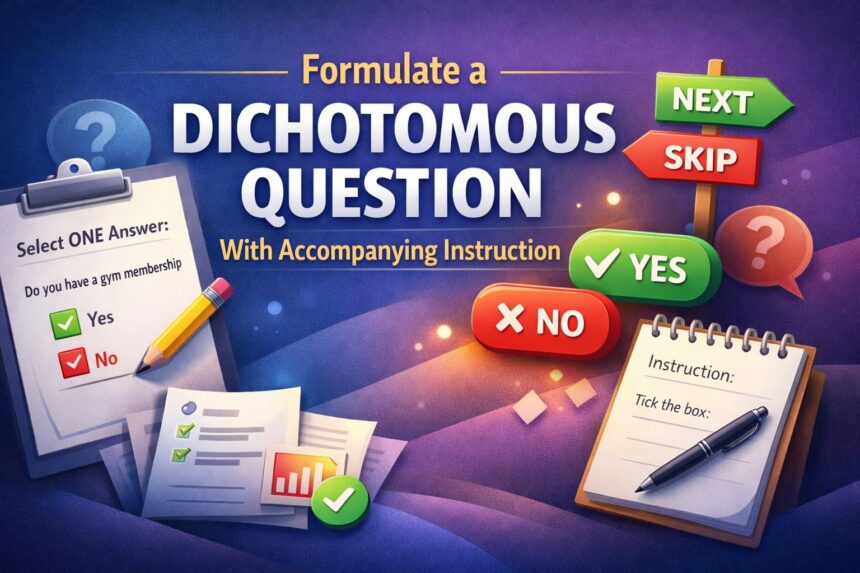
If you have ever answered a simple Yes or No question on a form or survey, you have already encountered a dichotomous question. This guide breaks down exactly what it is, how to write one properly, and why the accompanying instruction matters more than most people realize.
What Is a Dichotomous Question?
A dichotomous question is a type of closed-ended question that gives respondents exactly two answer options. These options are always mutually exclusive, meaning a person can only pick one. The most familiar form is a Yes or No question, though other pairs like True or False, Agree or Disagree, and Male or Female also qualify.
The word dichotomous comes from a Greek root meaning “divided into two parts.” In research and survey design, this format is prized for its simplicity. It cuts through ambiguity and forces a clear, definitive response from the person answering.
What makes this question type different from other closed-ended formats is that it offers no middle ground. There is no “maybe,” no scale, and no room for partial agreement. That directness is both its strength and its limitation, depending on the topic being studied.
What Is an Accompanying Instruction?
An accompanying instruction is a short directive placed before or alongside a dichotomous question. It tells the respondent exactly how to answer, what format to use, or what to do after they respond. Without it, even a simple Yes or No question can create confusion about what is expected.
For example, should the person circle their answer, tick a box, underline a word, or type a response? Should they move to the next question or skip ahead? The instruction removes that uncertainty. It acts as a guiding hand that makes the answering process smooth and error-free.
In professional research, leaving out this instruction is considered poor questionnaire design. It can lead to incomplete responses, inconsistent data, and frustration for respondents. A well-written instruction paired with a clean question is a basic standard in high-quality survey work.
The Three Core Parts of the Format
When you formulate a dichotomous question with an accompanying instruction, the structure always contains three elements working together. Each part has a specific job, and leaving any one of them out weakens the whole question.
Tells respondents how to answer or where to go next.
A clear, neutral question with only two logical answers.
Two mutually exclusive choices, clearly presented.
This three-part format is standard across academic surveys, medical intake forms, market research tools, and educational assessments. Once you understand the role each part plays, writing a well-formed question becomes straightforward.
Types of Instructions Used
Not all instructions serve the same purpose. Some simply tell the respondent how to physically mark their answer. Others direct the flow of the survey by telling people which question to answer next based on their response. This second type is called a skip logic instruction, and it is extremely common in longer questionnaires.
Here are the most commonly used instruction types:
- Format instructions — “Circle ONE answer only” or “Tick the appropriate box”
- Skip logic instructions — “If YES, go to Question 6. If NO, skip to Section C”
- Clarity instructions — “Answer based on your experience in the last 12 months”
- Honesty prompts — “Answer all questions honestly and to the best of your knowledge”
Choosing the right type depends on your survey’s structure. A single-page questionnaire may only need a simple format instruction. A multi-section research tool almost always needs skip logic to keep respondents on the right path.
Real-World Examples
Seeing the format in action makes it much easier to apply. Below are a few complete examples across different contexts, each combining a clear instruction with a well-formed question and two answer options.
Rules for Writing a Good Dichotomous Question
Writing this type of question looks easy, but common mistakes can quickly reduce the quality of your data. The most important rule is that the two answer choices must be mutually exclusive and exhaustive. That means they cannot overlap, and together they must cover every possible honest response.
Beyond that, the question itself must be clear and neutral. Loaded language, double negatives, or two ideas stuffed into one question will confuse respondents and produce unreliable answers. Each question should only contain one idea.
- Keep the wording simple and direct
- Avoid leading phrases that hint at a desired answer
- Never combine two questions into one sentence
- Make sure both options genuinely cover all real-world possibilities
- Always pair the question with a clear instruction
Following these rules consistently produces cleaner data, happier respondents, and more trustworthy research results. It is the kind of attention to detail that separates professional survey design from a rushed questionnaire.
Advantages of Using This Format
One of the biggest strengths of dichotomous questions is how easy they are to answer. Respondents do not need to think deeply or weigh multiple options. They see two choices, pick one, and move on. This keeps survey completion rates high and reduces drop-off.
From a data analysis perspective, binary responses are also very easy to work with. You get clean, countable data that can be expressed as percentages, ratios, or proportions without complex coding. This makes them a go-to choice for quick polls, screening tools, and filter questions in larger surveys.
Fast to answer
Easy to analyze
Supports skip logic
Reduces respondent fatigue
High completion rates
Limitations to Be Aware Of
Despite its usefulness, the dichotomous format is not suitable for every research situation. Its biggest weakness is that it forces respondents into a corner. When someone’s actual opinion sits somewhere in the middle, a Yes or No answer cannot capture it accurately. This can result in data that misrepresents how people truly feel.
For complex topics like attitudes, beliefs, or satisfaction levels, a Likert scale or multiple-choice format is usually a better choice. Dichotomous questions shine when the topic is clear-cut, factual, or binary by nature, such as eligibility screening, demographic classification, or factual verification.
When and Where to Use It
This question format is most effective as a filter or gateway question at the start of a survey section. It quickly separates respondents into groups so you can direct each group to the questions most relevant to them. This keeps the survey focused and prevents people from answering questions that do not apply to them.
Common real-world applications include:
- Eligibility screeners in clinical trials and academic research
- Patient intake forms in healthcare settings
- Quick customer feedback polls after a service interaction
- True or False knowledge checks in educational testing
- Demographic classification in census and government surveys
Final Thoughts
Formulating a dichotomous question with an accompanying instruction is a fundamental skill in survey design and research methodology. When done right, it produces fast, clean, and reliable data. The key is to keep the question focused, the options genuinely binary, and the instruction crystal clear.
Whether you are building a medical intake form, a customer feedback survey, or an academic questionnaire, mastering this format will make your work more professional and your data more trustworthy. It is a small skill with a big impact.
Frequently Asked Questions (FAQs)
What does it mean to formulate a dichotomous question with accompanying instructions?
It means creating a question that offers only two answer options (like Yes/No) along with a clear instruction that tells the respondent how to answer or what to do next.
What is a dichotomous question?
A dichotomous question is a closed-ended question that provides only two mutually exclusive answers, such as True/False or Yes/No.
Why are accompanying instructions important in surveys?
Accompanying instructions help respondents understand how to answer correctly and whether they need to skip or continue to another section.
Can dichotomous questions be used in all types of surveys?
They are best used in factual or simple surveys but not ideal for questions requiring detailed opinions or explanations.
What are common examples of dichotomous questions?
Examples include “Do you own a car?” (Yes/No) or “Is the sky blue?” (True/False).