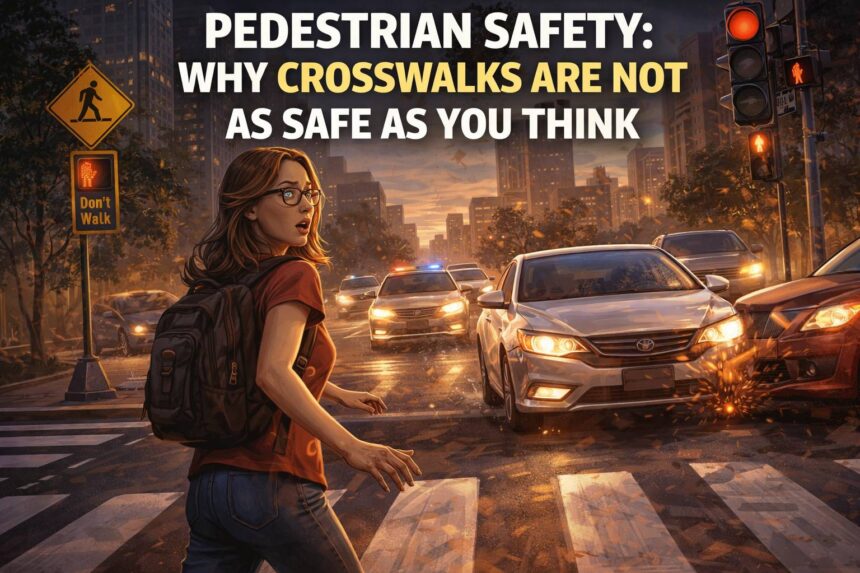
You step off the curb at a marked crosswalk, look both ways, and feel safe. After all, that white paint and blinking signal exist specifically to protect you, right? The hard truth is that crosswalks offer far less protection than most people believe, and in many urban environments, they may actually create a false sense of security that leads to serious injury.
In 2026, pedestrian fatalities remain one of the most alarming public health crises on American roads. Understanding why crosswalks fail, who is most at risk, and what your legal rights are after an accident can genuinely save your life or the life of someone you love.
The Crosswalk Illusion: Safety That Is Not There
Crosswalks were designed with a straightforward goal: give pedestrians a designated, visible space to cross and signal to drivers that foot traffic should be expected. But a design intention is not the same as a safety guarantee.
According to the National Highway Traffic Safety Administration (NHTSA), approximately 7,522 pedestrians were killed in U.S. traffic crashes in 2022, representing a 40-year high. More recent data from the Governors Highway Safety Association (GHSA) projects the annual pedestrian death toll continues to hover above 7,000 as of 2025, making the U.S. one of the most dangerous developed nations for people on foot.
What makes crosswalk data particularly troubling is that a significant percentage of pedestrian deaths occur at or near marked crossings and intersections, not in the middle of blocks where you might expect the most risk. A marked crosswalk signals to pedestrians that it is safe to cross but it does not always compel drivers to stop, yield, or even slow down.
Are Crosswalks Actually Safer Than Crossing Mid-Block?
This is one of the most frequently asked questions about pedestrian safety, and the answer is complicated. Marked crosswalks at unsignalized intersections have actually been shown in multiple studies to offer little to no safety benefit over unmarked crossings in certain conditions.
Research published by the Federal Highway Administration (FHWA) found that on multilane roads with higher traffic volumes and speeds, marked crosswalks without additional safety features such as pedestrian refuge islands, flashing beacons, or raised crossings can actually increase pedestrian crash risk compared to crossing elsewhere.
The critical factor is that drivers frequently fail to yield at crosswalks, particularly on roads with multiple lanes. A driver in the curb lane may stop, but a driver in the adjacent lane may not see the pedestrian and continue at full speed, a phenomenon known as the “multiple threat” problem.
Key pedestrian safety statistics for 2026:
| Risk Factor | Data Point |
| Annual U.S. pedestrian fatalities | Approx. 7,000+ per year |
| Pedestrian deaths involving speeding drivers | Over 30% of cases |
| Crashes occurring in darkness | More than 75% of fatalities |
| Pedestrian deaths at intersections | Roughly 20% of all pedestrian deaths |
| Increase in pedestrian fatalities since 2010 | Over 77% |
Sources: NHTSA Pedestrian Safety Overview, GHSA Pedestrian Traffic Fatalities
What Are the Most Common Causes of Pedestrian Accidents at Crosswalks?
Driver behavior is responsible for the overwhelming majority of crosswalk accidents. The leading causes include:
Distracted driving tops the list. According to the National Safety Council, cell phone use behind the wheel makes a crash up to four times more likely. When a driver is looking at a screen, a pedestrian in a crosswalk can be completely invisible until it is too late. At 40 miles per hour, a driver who glances down for just two seconds travels roughly 117 feet while effectively blind.
Driver speeding and aggressive driving remains a persistent danger. Higher speeds dramatically reduce stopping distance and increase the severity of any impact. A pedestrian struck at 40 mph has roughly a 45% chance of dying, compared to a 10% chance at 23 mph, per AAA Foundation for Traffic Safety research.
Failure to yield at crosswalks is technically a traffic violation in every U.S. state, but enforcement is rare, and cultural norms around yielding vary widely. In urban environments with heavy pedestrian traffic, driver compliance rates at unmarked or poorly marked crossings can be shockingly low.
Left-turn blindspot crashes are especially common. When a driver turns left at an intersection, their attention is focused on oncoming vehicle traffic. Pedestrians entering from the right are frequently outside their field of view, particularly at wide intersections where vehicles cross multiple lanes.
Poor lighting and visibility is a significant contributing factor. The NHTSA reports that more than 75% of pedestrian fatalities occur after dark, which means nighttime crosswalk crossings are disproportionately dangerous even compared to daytime jaywalking.
Who Is Most at Risk for Pedestrian Crosswalk Accidents?
Vulnerability at crosswalks is not evenly distributed. Certain groups face substantially higher risks:
Older adults aged 65 and above account for roughly 20% of all pedestrian fatalities despite making up only 16% of the U.S. population. Slower walking speeds mean they are more likely to still be in the crosswalk when the signal changes, and age-related changes in vision and hearing can make it harder to detect approaching vehicles.
Children are at heightened risk because their smaller stature makes them harder for drivers to see, and they may lack the experience to judge vehicle speeds and distances accurately.
People in low-income and minority communities face elevated pedestrian fatality rates due in part to infrastructure inequities. Research from the Smart Growth America Dangerous by Design report consistently finds that pedestrian fatality rates are higher in communities that have historically received less investment in pedestrian safety infrastructure.
Urban residents in the South and West face the highest per-capita risk. States like Florida, New Mexico, and South Carolina consistently rank among the most dangerous for pedestrians, largely due to road designs that prioritize vehicle throughput over pedestrian safety.
What Time of Day Are Pedestrian Accidents Most Common?
According to NHTSA crash data, pedestrian fatalities peak significantly during the evening and early nighttime hours, specifically between 6 PM and midnight. Friday and Saturday nights show the highest overall fatality counts in this window.
Rush hour periods, roughly 7 to 9 AM and 4 to 7 PM, represent elevated daytime risk windows because of increased vehicle volume. Interestingly, weekend afternoons are when pedestrian crashes involving children are most concentrated.
Weather also matters. Rain reduces driver visibility, increases stopping distances, and may cause pedestrians to move more quickly or erratically through crosswalks, all of which increase collision risk.
The Distracted Driving Crisis and Pedestrian Casualties
No conversation about crosswalk safety is complete without addressing distracted driving head-on. According to the Centers for Disease Control and Prevention (CDC), distracted driving claimed over 3,000 lives in a single recent year in the United States across all crash types, and pedestrians bear a disproportionate share of those deaths.
Smartphones are the primary culprit, but distraction is broader than phone use alone. Eating, adjusting navigation systems, interacting with passengers, and even daydreaming all contribute to driver inattention. At the moment a vehicle approaches a crosswalk, a distracted driver may not register a pedestrian until well after the point where safe stopping was possible.
The AAA Foundation for Traffic Safety found that mental distraction can linger for up to 27 seconds after a driver puts down their phone, meaning even a driver who puts the phone away before reaching the intersection may still be cognitively impaired at the moment a pedestrian steps into the crosswalk.
What Should I Do If I Am Hit by a Car in a Crosswalk?
If you or someone you know is struck by a vehicle at a crosswalk, the steps you take immediately afterward matter significantly, both for your health and for any potential legal claim.
Seek emergency medical attention first, regardless of how minor your injuries appear. Soft tissue damage, traumatic brain injuries, and internal injuries from pedestrian crashes can be deceptively subtle in the immediate aftermath due to adrenaline. Documenting your injuries through medical records also creates a critical evidence trail.
Contact law enforcement so that an official report is filed. A police report creates a contemporaneous record of the crash location, driver information, and initial witness accounts.
Document the scene as thoroughly as possible. Photographs of the crosswalk, vehicle damage, road markings, any traffic signals, lighting conditions, and your visible injuries can all be valuable later.
Gather witness information. People who saw the crash can provide independent corroboration of what happened, which is particularly important if the driver attempts to dispute liability.
Avoid giving recorded statements to insurance adjusters before consulting a lawyer. Insurance companies are businesses, and their initial contact is designed to gather information that can limit their liability, not to protect your interests.
Can I File a Legal Claim If I Was Injured in a Crosswalk?
Yes, and in most cases being in a marked crosswalk when you were struck is a powerful element in your favor. Drivers have a legal duty to yield to pedestrians in crosswalks, and a violation of that duty is a form of negligence. If that negligence caused your injuries, you may be entitled to compensation for medical bills, lost wages, pain and suffering, and other damages.
However, crosswalk accidents are not automatically straightforward. Insurance companies will often try to argue comparative fault, suggesting that the pedestrian was partially responsible by entering the crosswalk unsafely, looking at their phone, or crossing against a signal. In states with comparative negligence laws, even if you bear partial responsibility, you may still recover damages if your share of fault falls below a legal threshold.
If you were injured in the Houston area, consulting a Houston pedestrian accident lawyer who handles these specific types of cases is the most important step you can take to protect your rights. Pedestrian accident claims involve specific legal standards, and having an attorney who understands local traffic law, how to challenge insurer arguments, and how to document long-term injury impacts can make a substantial difference in what you recover.
How Does the Injury Claim Process Work After a Pedestrian Accident?
The process can feel overwhelming when you are already dealing with physical injuries and emotional distress. In general terms, an accident injury claim involves gathering evidence, establishing liability, calculating total damages including future medical needs, and negotiating with the at-fault party’s insurer or pursuing litigation if a fair settlement is not offered.
Timing is important. Most states impose a statute of limitations on personal injury claims, typically between one and four years depending on the jurisdiction, and evidence can disappear quickly. Surveillance footage gets overwritten, witnesses become harder to locate, and physical evidence at the accident scene changes.
For a more complete breakdown of what to expect from start to finish, this injury claim process guide for accident victims walks through each stage in plain language, from the initial investigation through settlement or trial.
Urban Design and the Road to Safer Crosswalks
The long-term solution to crosswalk danger is not simply asking pedestrians to be more vigilant. It requires systemic changes to how roads are designed, how drivers are educated, and how traffic laws are enforced.
Proven infrastructure improvements include high-visibility zebra striping, raised crosswalks that force drivers to slow, pedestrian hybrid beacons (also known as HAWK signals), median refuge islands, and reduced turning radii at intersections that naturally lower vehicle speeds. Leading Pedestrian Intervals (LPIs), which give pedestrians a few seconds of walk signal before vehicles get a green light, have been shown to reduce pedestrian crashes by up to 60% at treated intersections, according to NYC Department of Transportation research.
The GHSA recommends that cities conduct regular safety audits of high-risk crosswalk locations and prioritize pedestrian infrastructure investments in communities with the highest injury rates.
Final Thoughts: Know Your Risk, Know Your Rights
Crosswalks are a necessary feature of urban life, but they are not a shield. In 2026, the statistical reality is that pedestrians remain far more vulnerable than most people realize, and the visual cue of a marked crosswalk does not guarantee that approaching drivers will stop, slow down, or even see you.
The most protective steps pedestrians can take are to make eye contact with drivers before stepping off the curb, avoid using phones while crossing, wear visible clothing after dark, and understand that the right of way is a legal concept, not a physical barrier.
And if the worst does happen, knowing your legal rights and acting quickly to document your injuries and consult an attorney can be the difference between absorbing devastating costs alone and receiving the compensation you deserve.