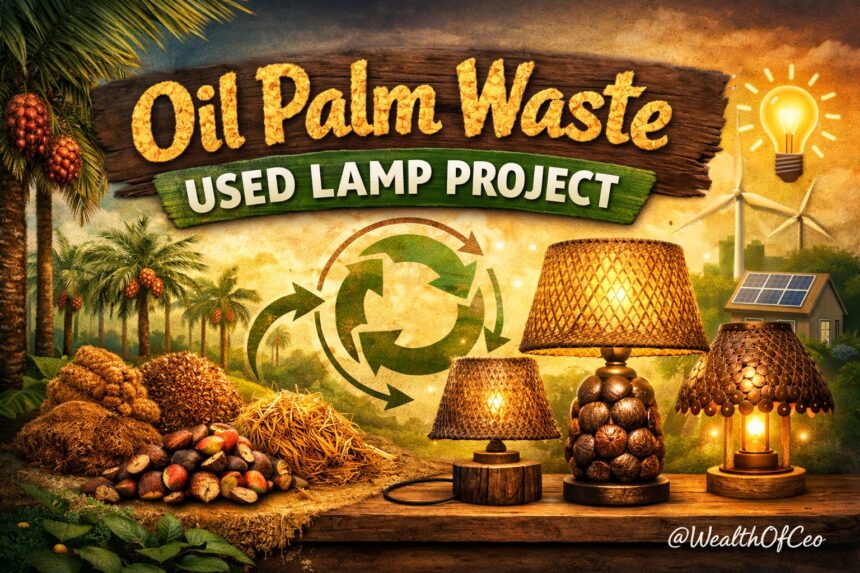
The oil palm waste used lamp project focuses on converting agricultural byproducts into functional lighting solutions. It is built on the idea that materials often treated as waste can be redesigned into useful, durable products with minimal environmental impact. This concept is widely explored in sustainability studies, design engineering, and community-level innovation programs.
In regions where oil palm production is high, waste accumulation creates disposal and pollution issues. This project addresses that problem by transforming fibers, shells, and other residues into lamp components. It combines waste management with practical product design, making it relevant for both academic exploration and small-scale production initiatives.
What Is the Oil Palm Waste Used Lamp Project and How Does It Work
This project is a process-driven approach where oil palm residues are collected, treated, and converted into parts of a lamp such as the base, shade, or decorative casing. The goal is to reuse materials that would otherwise be discarded, turning them into a stable and usable lighting product. It typically integrates simple electrical systems with handcrafted or semi-processed organic materials.
The process begins with sourcing waste like empty fruit bunches, palm fibers, or shells. These materials are cleaned and dried to remove moisture, which is critical for durability and safety. After that, they are shaped or compressed depending on the intended design, often using basic tools or molds.
Once the structural components are ready, they are assembled with a lighting unit, usually an LED due to its low heat output and efficiency. The final product is tested for stability and safety. This step is often overlooked in academic projects, but it is essential for real-world usability.
A common mistake is assuming that raw waste can be used directly without treatment. Without proper drying and binding, the material may degrade quickly or pose safety risks. Understanding material behavior is key to making the project functional rather than purely decorative.
Why Is This Approach Considered Sustainable and Practical
The project is considered sustainable because it reduces reliance on new raw materials while also addressing agricultural waste. Instead of burning or discarding residues, the material is repurposed into something with practical value. This aligns with circular resource use, where outputs from one process become inputs for another.
From a practical standpoint, the materials are often locally available in palm-producing regions. This reduces transportation costs and makes the project accessible for small communities or student-level innovation. It also encourages localized production rather than dependence on imported goods.
Another important factor is energy efficiency. Most designs incorporate low-power lighting systems, which complement the environmental purpose of the project. However, sustainability is only achieved if the product is durable and usable over time, not just eco-friendly in concept.
A frequent misconception is that any recycled product is automatically sustainable. If the lamp breaks easily or cannot handle heat or humidity, it may end up as waste again. True sustainability requires durability, usability, and safe design working together.
What Materials and Design Methods Are Commonly Used
The materials used in this project vary depending on availability and design goals, but they typically include palm fibers, shells, and pressed biomass boards. These materials are chosen for their texture, strength, and ability to be shaped into functional forms. Some designs also combine natural waste with supporting materials like metal frames or adhesives.
Processing methods range from simple handcrafting to basic mechanical compression. Fibers may be woven or pressed into sheets, while shells can be cut and arranged to create structured patterns. The choice of method depends on the scale of the project and the tools available.
Design plays a critical role in ensuring both function and safety. Proper ventilation, stable bases, and secure wiring are essential elements. Many beginners focus too much on appearance and ignore structural balance or heat management, which can lead to unstable or unsafe lamps.
Another important aspect is finishing. Coating or sealing the material can improve durability and resistance to moisture. Without this step, natural materials may absorb humidity and degrade over time, especially in warm climates.
What Challenges or Limitations Should Be Considered
One of the main challenges is material consistency. Since oil palm waste is a natural byproduct, its quality can vary depending on source and processing conditions. This makes it harder to achieve uniform results, especially in larger-scale production.
Durability is another concern. Organic materials are more vulnerable to moisture, insects, and wear compared to synthetic alternatives. Without proper treatment and design, the lifespan of the lamp may be limited, which affects its practical value.
There are also safety considerations. Electrical integration must be handled carefully to avoid hazards such as overheating or short circuits. Using low-heat lighting and proper insulation is essential, but often overlooked in basic project setups.
Finally, scalability can be difficult. While the project works well at a small or experimental level, turning it into a consistent commercial product requires better processing techniques and quality control. This gap is where many projects struggle to move beyond prototypes.
Is This Project Suitable for Real-World Use or Academic Work
This project is well-suited for academic purposes because it demonstrates multiple concepts, including sustainability, material science, and product design. It allows students to explore real-world problems and develop practical solutions using accessible resources.
For real-world use, the project has potential in niche markets such as eco-friendly home decor or handmade products. Its success depends on the quality of execution, particularly in durability and safety. A well-built lamp can be both functional and visually appealing.
However, it is not always a direct replacement for conventional lighting products. Standard lamps are designed for long-term reliability and mass production, which can be difficult to match with natural materials without advanced processing.
The most effective use of this project is as a bridge between experimentation and practical design. It encourages thoughtful use of resources while highlighting the importance of engineering, not just creativity.
Conclusion
The oil palm waste used lamp project represents a practical intersection of sustainability and design. It offers a meaningful way to reuse agricultural byproducts while creating functional lighting solutions. Its value lies not only in the final product but also in the process of understanding materials, safety, and real-world usability.
For students, it provides a strong foundation in applied problem-solving. For broader use, its success depends on careful design, proper material treatment, and realistic expectations. When approached with technical awareness rather than just creativity, it becomes more than a concept and turns into a viable, responsible solution.
FAQs
What is the oil palm waste used lamp project?
The oil palm waste used lamp project is a sustainable design approach that converts palm residues into functional lighting products. It combines waste management with practical lamp construction using treated natural materials.
What materials are used in this type of lamp?
Common materials include palm fibers, shells, and empty fruit bunches. These are cleaned, dried, and shaped to form lamp structures with added electrical components.
Is this project environmentally beneficial?
Yes, it reduces agricultural waste and limits pollution from burning residues. Its impact depends on proper design, durability, and responsible material treatment.
Can this lamp be used safely at home?
It can be safe if built with proper insulation and low-heat lighting like LEDs. Poor wiring or untreated materials can create safety risks.
Is this project suitable for students or beginners?
It is ideal for students as it teaches sustainability, design, and basic engineering concepts. Beginners can complete it with simple tools and guided steps.